
On the 27th Anniversary of the Americans with Disabilities Act
The 27th Anniversary of the Americans with Disabilities Act
“The continuing existence of unfair and unnecessary discrimination and prejudice denies people with disabilities the opportunity to compete on equal basis and to pursue those opportunities for which our free society is justifiably famous, and costs the Unites States billions of dollars in unnecessary expenses resulting from dependency and nonproductivity.”
– Americans with Disabilities Act of 1990, Section 2 part 9
On July 26, we will recognize the 27th Anniversary of the signing of the Americans with Disabilities Act (ADA) of 1990. The ADA remains America’s landmark piece of legislation supporting the inclusion of individuals with disabilities at work, on public transportation, in businesses, and in our communities.

Signed into law by President George H. W. Bush, the ADA represented a bi partisan effort from Congress as well as input from individuals with disabilities and disability advocates. The first part of the effort was to hear from individuals with disabilities. For this role, disability advocate and Vice Chair of the National Council on Disability, Justin Dart took the lead. In two ground breaking National Tours, Justin Dart Jr. visited all 50 states and held conversations with individuals with disabilities to learn what they would want in a civil rights law. This gathering of individuals with disabilities outside of medical or charitable settings had never been done before and the information that Dart compiled would be essential to the drafting of the new Bill. During this time, Lex Frieden (convener of the Anthem National Advisory Board), who had also worked with Dart on the National Council on Disability (NCD) was appointed to coordinate the newly formed Congressional Task Force on the Rights and Empowerment of Americans with Disabilities. Frieden would further refine the information gathered from the Justin Dart Tours as well as oversee the writing of Robert Burgdorf, and these two pieces would make up a significant part of the first drafts of what was to become the ADA. Finally, all of the information from advocates and scholars was compiled by policy experts serving in the House and Senate and the ADA was introduced in the Senate by Senators, Harkin, Hatch, Welkin, Dole and Kennedy with support from Rep. Major Owens (D-NY), former head of the CDC). During its signing, President George H.W. Bush remarked that “Every man woman and child with a disability may now pass through once closed doors into a bright new era of equality, independence and freedom.”
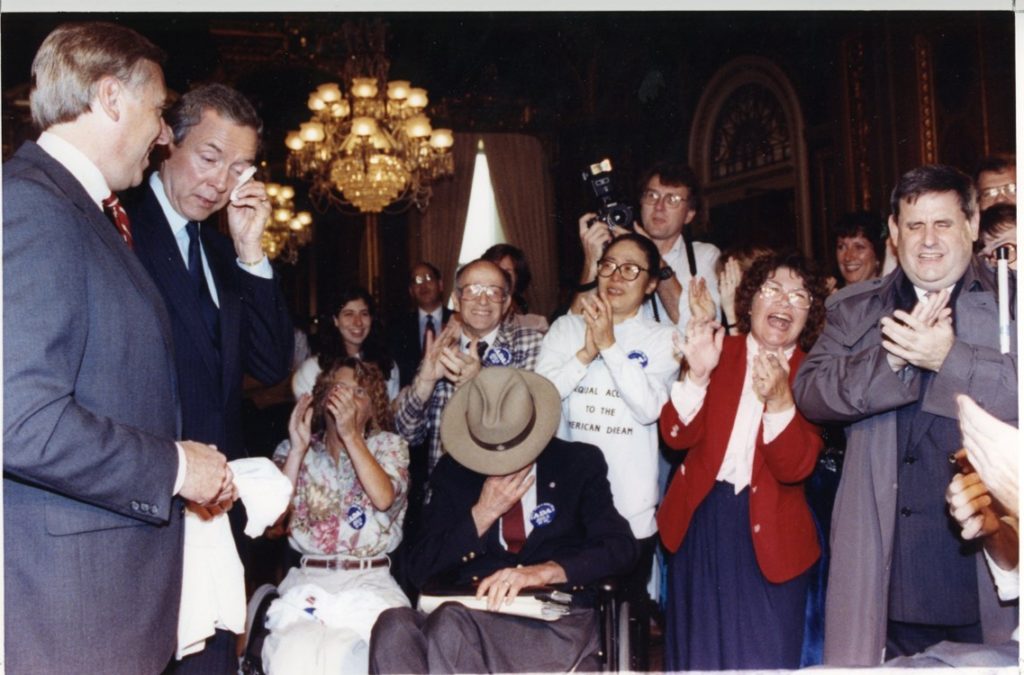
While the ADA is not the first piece of comprehensive legislation to protect Americans with disabilities, it was the most innovative in its uncompromising civil rights protections. Unlike previous legislation which offered very limited protections to a very specific group of people, the ADA used a civil rights approach that offers its protections to all Americans. The ADA ensures that anyone – even if they have just acquired a disability, is protected from disability discrimination. The ADA offers protections to individuals with sensory and mobility disabilities, and individuals with intellectual and developmental disabilities, but also extends it protections to individuals with chronic conditions, cancer survivors, and individuals with mental health and substance use disorders. The ADA was also groundbreaking in its inclusion of individuals with perceived disabilities. This includes individuals with conditions whose symptoms manifest as disabilities -- as in the case of a mobility disability brought about by a change in blood pressure medication or fatigue brought about by cancer treatment. The ADA also gives protection to individuals who have medical outcomes that are not readily understood by most of the public. At the time, this was specifically supportive of individuals who were HIV positive or had autoimmune disorders. There was still a significant amount of misinformation about AIDS and HIV in the 90s and this community which was in need of supports was consistently being discriminated against at school, work and in many parts of their communities. For this group, the ADA was an important source of justice in many of these cases.
The ADA protects you at work
The ADA offers protections at work and when looking for a job – protecting individuals from discrimination in the job application procedures and hiring process, as well as retention, advancement, and job training. The ADA also outlines the reasonable accommodation process – showing that accommodations can be inexpensive and ensuring that employers provide their employees with the tools they need to be productive workers.
The ADA Protects you in your community
The ADA offers protection against discrimination in Public Accommodations. This means that businesses are required to be accessible and that any person has the equal right to access businesses and purchase of goods and services.
The ADA Protects you on the Move
One of the mainstays of the ADA has been access to public transportation. The ADA ensures that any public transit be physically accessible for individuals with mobility disabilities and offers supports and accommodations for those with sensory disabilities.
What’s Next?
Though it is 27 years old, the future of the ADA continues to be even more important for a generation of Americans who have refused to stand on the tradition or stereotype of “getting old.“ For the generation of aging Baby Boomers that are approaching retirement, and plan on continuing to live in their homes and communities the ADA offers the protections that will ensure inclusive, accessible communities that are a key component to aging and living at home.

The ADA also continues to influence disability legislation in the US and abroad. Many countries have adapted their own versions of the ADA to support individuals with disabilities around the world. Even the Convention for the Rights of People with Disabilities (CRPD) put forth by the United Nations uses the example of the ADA as a basis for its structure and protections.
At the NAB we continue to partner with groups like the American Association of People with Disabilities (AAPD) and the National Council on Independent Living (NCIL) to further promote disability inclusion and access in every part of our lives. On July 26th we will be joining with these organizations to recognize the anniversary of the ADA. Lex Frieden who was one of the architects of the ADA, has continued his leadership in advocating for individuals with disabilities and currently serves as the Convener of the National Advisory Board (NAB) on Improving Health Care Services for Older Adults and People with Disabilities. In this role, Lex and the NAB help to continue the work of the ADA by creating a more accessible and inclusive America for everyone. It is our hope that as new frontiers of access are explored, the ADA continues to evolve and be at the forefront of inclusion for all.